Gringo trail, Peru

5.00
1 review
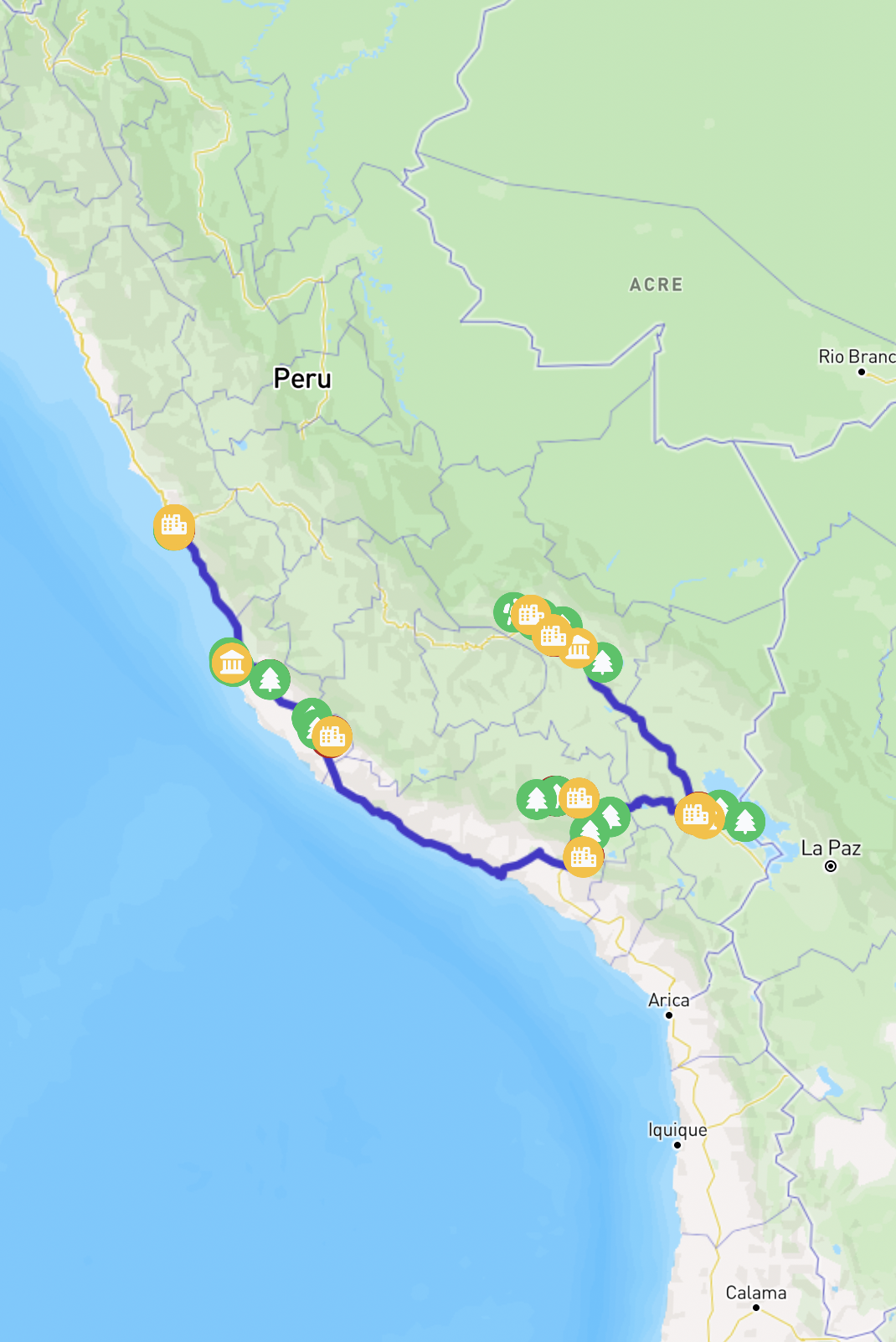
This route is perfect for those who are eager to combine deserts, mountains and ocean views. You will see them all! Starting at Lima, following along the Pacific Coast and then all the way up to the mountains through Nazca lines and Titikaka floating islands.
- Days10
- Distance2,029 km
- Spots51
- IntensityIntense
Full route
- Lima
- Lima - Península de Paracas - Huacachina - Nazca
- Nazca - Nazca Lines - Arequipa
Our to-do list
- Visit Machu Picchu as it’s a once-in-a-lifetime experience
- Enjoy the fabulous view of how the desert of Paracas meets the ocean and try buggy (the area is huge)
- Try sandboarding on the top of the dunes of the oasis Huacachina
Interesting places we didn’t visit
- Paracas Candelabra: a mysterious geoglyph resembling a candlestick etched into a hillside in Peru. It’s possible to view just from the water.
- Chauchilla Cemetery: an ancient burial site in the Nazca Desert known for its well-preserved mummies.
- Maria Reiche Museum: the museum honors the pioneering work of Maria Reiche in studying the Nazca Lines.
- Distance0 km
- Spots7
Lima is a very contrasting city. When driving from the airport, you first notice the broken roads and slums. However, as soon as you get onto a road that runs along the ocean, you forget about that because the coastline is incredibly beautiful.
Areas like Miraflores are very pleasant, and you feel safe in them. Everything is stunning, a bit chaotic and casually Latin American, but with style. At the same time, the electric fences on many houses remind you that complete safety here is a privilege.
What to visit in Lima:
- Miraflores area.
- Miraflores Chinese Park with a cool view of the ocean shore.
- Lima Main Square.
- Not far from the city centre, there is a Muninet Parque La Muralla.
- Huaca Pucllana Site Museum, dedicated to an ancient civilization even before the Incas.
- And next to it, there is a relatively expensive but very tasty restaurant of Peruvian cuisine, Huaca Pucllana.
- Distance500 km
- Spots7
-
Península de Paracas - the place I would return to for more than just several hours. It makes sense to ride between different beaches and see how the panoramic view changes. The peninsula itself is a vast, flat desert with small hills.
We came to Atenas Beach first. Nothing special, nice view. The second stop was Playa Roja, which invoked intense emotions as the views were breathtaking.
If we went there again, I would spend a whole day in Paracas to travel around all corners of the peninsula, for example, on a buggy. It doesn’t have any incredible sights, but the atmosphere of the desert, the ocean, and the lack of people is very relaxed.
-
Huacachina is a very Instagram place looking from the top. And I understand why - not every day you see an oasis in the middle of the desert. We wanted to try sandboarding, but unfortunately, it was already too late.
-
Nazca - the village is relatively small, and since we came after midnight, we didn’t explore it properly.
- Distance570 km
- Spots5
-
The Nazca Lines are a truly mesmerizing and enigmatic archaeological wonder. We bought a flight tour for 30 minutes. Pilots instructed us in what order they would show the figures before the flight, having previously distributed the flight diagram. The plane was for four, quite fast and light. I can’t say that I was trembling or something else, moreover, when you see geoglyphs, you get distracted and forget to be nervous.
The pilot tilted the plane over the lines gently, first to the right and then to the left, so the aircraft’s wing would point precisely at the drawing. Therefore, no matter which side you sit on, you will see the lines and pictures of the Nazca desert.
-
In Arequipa we just walked around the city and went to the central square, so nothing special.
- Distance251 km
- Spots6
-
We drove to the Colca Canyon on the Salinas and Aguada Blanca National Reservation road on the left side of the park, not directly because the road following through the mountains was in bad condition. But if you are eager to see the volcanos, you may try anyway. On the park’s territory are volcanoes El Misti and Chachani, as well as mountain salt lakes.
But even though we did not go deep into the park, we still managed to enjoy the landscapes and saw a lot of vicunas. They are considered sacred animals in the Andes. One of the points where we bumped into them was Lagunas de las vicuñas, and we took the perfect photos of these gentle creatures.
-
Mirador Cruz del Cóndor is an observation point with a good view of the Colca Canyon; we stopped there and went only a little further from this place. Considering that the canyon is massive, you could choose any parking spot.
As far as I am concerned, you can hike there for a few days, but we didn’t go as we went for five days to Machu Picchu.
Unfortunately, we did not see the condors that live in the canyon in huge numbers. Later, we found out that it is necessary to arrive at about 6-7 in the morning. And also, there is a chance to meet them when the wind is outside.
-
Chivay is quite a small and provincial town, convenient for spending the night in the canyon area.
- Distance322 km
- Spots8
-
Mostly, Aymara and Quechua Indians live in Puno, and more than in other towns, people wear bright clothes there. But in general, there are also many unfinished houses (not to pay tax), dusty roads and surprisingly few foreign tourists. Peru has developed domestic tourism, and many people come to the city from other places.
-
Titicaca Lake impressed us with its size and water surface. It is the highest navigable lake in the world. We liked to watch it in sunny weather, the impressions were unusual, because the sun heated up very much, but a cold wind blew from the lake.
The water itself was pretty transparent, however, on the shore where we boarded the boat, there was a peculiar smell due to the rotting of reeds (something between methane and peat).
-
We decided to stay for a night on Uros floating islands. We understood it was a touristic area, but it still looked unique. We left the car in the parking from our hotel in Puno (ask your host about it).
The story goes that two warring tribes lived on the coast along with the tribe of the Uros. They first forced the Uros out of this land. Then the Incas came, the Spaniards, and the Uros, who at some point had to go to shore, thought that a free life was better.
The owner met us at the pier and took us by boat to the house. When we got off the boat, we were very warmly welcomed; generally, the people here are incredibly hospitable and kind even though people live very poorly.
- Distance386 km
- Spots5
The way from Puno to Cusco had a rough start from the very beginning.
Firstly, when you enter Puno, at some place, the road goes sharply down the street. Accordingly, to leave the city, you need to go sharply up. Google built a route that left us on a broken gravel road, and we did not have enough power to go up the hill. Additionally, there was some event, so some of the streets were blocked. In short, I had to find a slightly less steep climb and drive into it with acceleration.
Secondly, when we drove away from Puno, we got into a massive traffic jam on the road with stones scattered all over it. It turned out that it was a strike of local peasants who blocked all exits from that area. We miraculously found a detour through neighbouring villages and fields and drove an extra hour and a half. At some point, we passed a road where cheerful farmers walked along the side of the road and rolled cobblestones to block this road as well. We could have stayed there if we had left a couple of hours later.
Thirdly, a little later on the highway, the police stopped us, and the policeman found fault with my documents. First, he explained that my driving license do not apply here (which is not true), and then it turned out that the car had expired insurance. The only thing that saved me was that I pretended to be ignorant and said that I didn’t understand anything and it was better for him to contact the rental office. I typed this sentence into google translate along with their phone number and he let me go. It’s not a very pleasant experience, anyway, you have to be prepared for it.
And finally, about 2-3 hours before arriving in Cusco, we drove into a terrible thunderstorm, and there was just the most mountainous region. As a result, we drove under the clouds, then it got dark, and lightning began to strike. It is not very pleasant to move along the road on the side of a mountain when 5 minutes ago you saw how lightning strikes this and neighbouring mountains. Well, the cherry on the cake became a hellish downpour, which also pretty scared us.
In Cusco we returned the car and then took tours and public transport.
- Distance0 km
- Spots13
-
Cusco is the ancient capital of the Inca state, so there are a bunch of sights. As we stayed there for 4 days, the apartment was a crucial thing. I recommend this loft as it is in a very convenient location and quite cosy. One moment may confuse you: it has a totally transparent shower room.
What to see in Cusco during the days of acclimatization before upcoming hiking to the mountains.
- Fortress of the Inca (Saqsaywaman), known for its massive stone walls and historical significance. You can walk there right on foot, you have to climb quite a lot along the way, but the views of the city are mesmerizing. Another great advantage is that alpacas walk on the territory of the fortress.
- San Pedro Central Market, pretty interesting market.
- Cuzco Main Square.
- If you’re not vegan and love to try the exotic food, eat alpaca steak and kui - baked local guinea pig. There are, in principle, a lot of places that cook both.
-
We took an Airbnb experience and booked the tour with a local guide to Parque Arqueológico Pisac - Moray - Salineras de Maras - Ollantaytambo for one day. They are all located in the same region - the sacred valley. Each attraction is interesting in its own way and differs from the others. The Moray circles were the least visually impressive; they could be more beautiful, but from a cultural point of view, it was interesting to hear that this is essentially an Inca agricultural laboratory. The Salineras de Maras is an awe-inspiring place. Ollantaytambo is a huge Inca city with classic terraces, and Pisac is located high on the mountain, which is also impressive.
-
Based on our experience, it is better to reserve one day for a trip to the Vinicunca (Rainbow Mountain). There you can go hiking or climb on horseback, but the main thing is that you need at least 4 hours to go there. The trail is not so long, but getting to the start of the ascent can take about an hour and a half.
There are no ancient ruins, but many mountain views, all sorts of glaciers, valleys and so on. Some mountains are actually green and red. In short, this is definitely a must-see. But it might be tough for unprepared people since the height is about 5500, so you can get mountain sickness if you go without preliminary acclimatization.
-
I remember walking with local farmers and their llamas and alpacas through the mountains in Chinchero (it’s pretty close to Cusco). We rate it at 100/10. You hung out with animals, some of them were given lead on a leash. We had a chance to feed a baby alpaca with milk from a bottle. The views that opened up were incredible, and after that, we were immediately fed homemade guacamole and local food.
-
Our trip ended with hiking to the mountains - Machu Picchu (5 days). It’s a once-in-a-lifetime experience. It touched me profoundly more than anything during the holiday.
We booked the classic Salkantay 5-day trek. It’s less famous than the classic Inca Trail, however, it might be more picturesque. If you are not an experienced hiker, the track will seem quite tricky (more precisely, there is a challenging second day), but it’s worth it. Be sure to go on this path with guides because there are wild places with no roads or cafes. We had a group with guides, a cook and assistants, they cooked food for us.
Our path was Cusco - Mollepata - Soray - Huayracmachay - Collpapampa - Win’aypoco - Abra de Aobamba - Llaqtapata - Aguas Calientes - Machu Picchu - Cusco.
We booked the trail with non-English-speaking guides, but if you are interested or want to compare prices, check the route anyway.