Catalonia

5.00
1 review
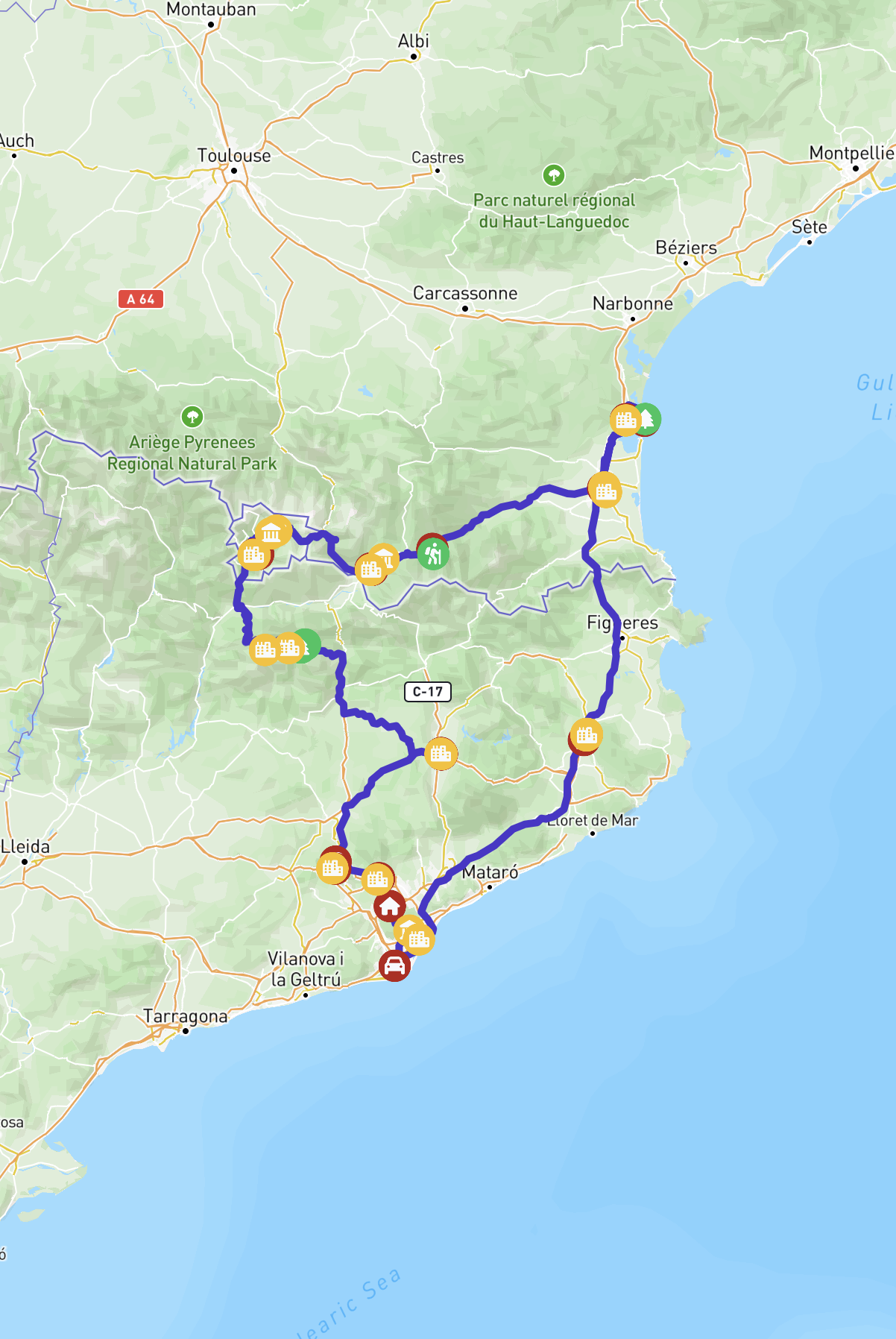
One of the most distinctive regions spanning Spain and France, with so much more to offer than Barcelona. We discovered that Catalan is spoken in Andorra, that Spain has an exclave in France, that high in the mountains there’s a village where Picasso’s artistic talent was reborn, and that some of the world’s best restaurants are found here. Once again, we came away convinced that Spain is the perfect country for a road trip, even in the heat of summer, there’s always something new to discover.
- Days9
- Distance834 km
- Spots46
- IntensityChill
Full route
- Barcelona - Girona
- Girona - Fitou
- Fitou - Perpignan - Fitou
Our to-do list
- Explore the historic centre of Girona, admire its beautiful architecture, and walk along the river to spot nutria (Day 1)
- Relax at the villa in Fitou, enjoy the pool and sea views, and spend some time at the beach (Day 2–3)
- Explore the picture-perfect city of Perpignan, including Le Castillet, Basilique-Cathédrale Saint-Jean-Baptiste, and others (Day 3)
Interesting places we didn’t visit
- Download all the places
- Distance114 km
- Spots4
was the first city on our route. I’d heard a lot about it, probably mostly because of the football club, but I’d always wanted to see it for myself. It’s definitely a city worth visiting, with stunning architecture, a lively historic centre, and a fascinating history, it was founded by the Romans and changed hands many times over the centuries.
is also famous for the Girona Temps de Flors festival, when the streets are transformed with carpets of flowers, creating an incredible backdrop for the city’s beautiful cathedrals and museums.
And if you take a walk along the river, you might unexpectedly spot a cute family of coypu hiding in the bushes. Apparently, they have plenty of space there and seem to be living quite happily.
is also home to quite a few restaurants that are not just good, but genuinely world-class, including El Celler de Can Roca, which has been named the best restaurant in the world twice.
- Distance127 km
- Spots5
That day, we simply drove to our .
- Distance57 km
- Spots6
We decided to combine our trip around Catalonia with our fifth wedding anniversary, so we rented the most beautiful villa with a pool and sea views. For the next three days, we mostly lounged around there, only occasionally venturing out to the beach.
We did make it as far as , a picture, perfect city with a distinctly Spanish-French feel. In the 13th century, it even served as the capital of the Kingdom of Majorca, which is why you can find a real palace there.
Overall, the city feels surprisingly Spanish, and considering it only became part of France at the end of the 17th century, which, by European standards, really wasn’t that long ago, it’s easy to see where that Spanish character comes from.
Walking through the city centre, you’re unlikely to miss Le Castillet, the former city gates, or the distinctly Spanish-looking southern Gothic Basilique-Cathédrale Saint-Jean-Baptiste. You’ll also come across the beautiful mansions Hôtel Pams and Casa Xanxo.
The view from , however, feels much more French, with tall trees and elegant buildings lining the canal.
- Distance33 km
- Spots2
For one day, we headed to , a long, sprawling beach where you can easily find a spot with no one else around for dozens of metres. My husband really enjoyed the peace and quiet. At the same time, there are plenty of bars and restaurants where you can grab something to eat or have a cocktail, so you can be as social as you like.
- Distance125 km
- Spots5
Of course, I couldn’t resist planning a hike in the Pyrenees while we were there. They’re absolutely stunning mountains, and although we only got to see a small part of them, it was well worth it. is probably one of the best choices in the region during hot weather, as most of the trail is shaded.
The hike looks much more intimidating than it actually is. There’s a cable running along the entire trail, and there’s plenty of room to walk. The elevation gain isn’t huge either. We went counterclockwise so that the steepest climb would come at the very beginning of the hike. We decided not to do the entire route, as completing it would require splitting the hike over two days and spending the night in a mountain refuge at the end. But if you’re brave and fit enough for it, the hike is incredibly varied and interesting, so I’d definitely recommend giving it a go.
We spent the night in a very interesting little town called , which is a Spanish exclave that managed to retain its status thanks to what was essentially a historical loophole. After the war between France and Spain ended, the Treaty of the Pyrenees was signed, under which Spain ceded a number of northern territories to France. However, there was a legal technicality: the treaty specifically referred to the territories being transferred as “villages.” , historically, had the official status of a “town” (vila) and had once been the ancient capital of the Cerdanya region, so it remained under Spanish rule.
Overall, it’s a charming little town with its own distinctive architecture and, as we discovered, a surprisingly large number of good restaurants for a place this small. One thing that surprised us was how few people were out on the streets in the evening. There were just a few people hanging around outside the local grocery shop. As far as we understood, the town gets much busier in winter, when people come to ski at the nearby resorts.
Overall, it was a pretty cool experience. If you ever want to stay in a tiny little town that doesn’t even have its own police station, is definitely one to consider.
- Distance78 km
- Spots7
We visited in the first year of our relationship, and we remember it not only as a beautiful winter resort but also as a very romantic place. Of course, it looks quite different in summer, the mountains are lush and green, and there’s much more sunshine, but winter has a special atmosphere of its own. I’d definitely recommend visiting this town, surrounded by mountains on all sides.
There aren’t many historical or entertainment attractions here, as the main draw is the surrounding nature. But we stopped by to see and walk across the , one of the longest suspension bridges in the world. It looks impressive, but it’s better to buy your tickets online in advance, as they aren’t sold on site, and there’s no internet connection there either.
On our way into town, we stopped at the to take in the breathtaking views of Andorra, from 500 metres above the gorge and 2,000 metres above sea level. From up there, you can really see that although Andorra’s mountains aren’t particularly high, they’re perfect for winter sports.
You can also see just how many hiking trails there are across the country.
As for itself, it doesn’t take long to walk from one end to the other, about half an hour. It may be tiny, but it’s surprisingly cosy and charming. Of course, much of the city is made up of shops, as the entire country is essentially one big duty-free zone. But the undisputed king of this shopping kingdom is . I’ve never seen such an incredible variety of products under one roof. I was blown away by it seven years ago, and it still impresses me today, I walk around it like a child, amazed by everything I see.
The cherry on top was the best hotel we’ve ever stayed at in all our travels: . We’ve never stayed anywhere quite so thoughtfully designed, stylish, and comfortable. I could go on singing its praises, but honestly, you just need to stay there yourself and you’ll understand.
- Distance175 km
- Spots9
That day, I deliberately chose a route that would let us enjoy the scenery as much as possible. The road runs through Cadí-Moixeró Natural Park and is incredibly green, beautiful, and deserted. In an hour and a half of driving, we passed only three or four cars. Apparently, the road is so winding and challenging that no one ventures along it unless they really have to.
There are several along the way that look incredibly old and, I’d say, partly abandoned. I later checked them out on Booking.com, though, and it turns out that people come there in winter to holiday and ski, so they’re not completely deserted. One of them even has the Centre Picasso museum. Apparently, after spending a summer there in a sort of voluntary exile, far away from everyone, and these villages were seemingly visited mostly by smugglers at the time, Picasso radically changed his artistic style. If I ever wanted to disappear from the rest of the world, this is exactly where I’d do it.
We then made our way to the truly spectacular mountain, which rises above the entire valley like a queen wearing a crown. I’d also recommend stopping at , a stunning viewpoint with breathtaking views. And if you’re up for it, you can even set off on a hike up the mountain directly from there.
We spent the evening and the night in the city of . At first, we couldn’t figure out what was going on, but there were pictures and images of giant dolls all over the streets. It turns out the city is famous for its enormous figures the Count and Countess of Osona, who are carried through the streets on people’s shoulders during local celebrations. We never quite figured out what exactly they represent, but today they’ve become one of the city’s main symbols and dance through the streets every year during the local festivities.
- Distance96 km
- Spots6
The next day, we decided to visit one of the most popular yet rather unusual places in the area: . It’s basically one giant playground for adults, with mountains, a monastery, a museum, a library, and even hiking trails. I was most interested in seeing the place itself—I’m fascinated by temples built high in the mountains, especially in such challenging conditions.
is also home to one of Catalonia’s most important religious symbols: the Black Madonna, which was saved when the monastery was looted.
Overall, it’s a fascinating place, but I’d definitely recommend being prepared to pay the full ticket price, which includes pretty much everything, and then taking your time to explore for the whole day.
As for getting there, there are several options if you’re travelling by car. We left ours at the free because I wanted to take the train (Cremallera de Montserrat) up to the monastery and get a better view of the mountains along the way. If you’d rather drive all the way up, there’s a fairly large car park at . You can also reach the monastery by cable car, called Aeri de Montserrat, which is probably an even more thrilling option if you’re not afraid of heights.
Once you’re there, there are two more funiculars: one takes you to the cave, while the other, the Funicular de Sant Joan, takes you even higher. And that’s not even mentioning hot-air balloon rides, although unfortunately those aren’t included in the ticket price.
Originally, we had planned to spend the night in , walk around the city in the evening, and see a few interesting places. However, our accommodation turned out to have a broken air conditioner, so we had to find a new hotel at short notice. As a result, we ended up leaving the city and staying somewhere else. So I wouldn’t recommend treating the place I’ve marked as somewhere that’s actually worth visiting.
- Distance29 km
- Spots2
Since we still had plenty of time before our flight, we decided not to go into Barcelona and waste time looking for parking, and instead spend the time doing something useful at the . When we were approaching, I noticed there seemed to be an awful lot of families with children heading into the museum, and I thought there probably wouldn’t be much there for us. But I was completely wrong.
Yes, children will definitely enjoy it, but there’s plenty for adults without kids to see as well. The museum has a huge variety of interactive physics experiments, biological specimens, and even what is essentially an ecosystem-zoo in the form of The Living Rainforest, with birds and fish living together in the same environment.
I’d definitely recommend visiting, we had a fantastic time and left with loads of great memories.