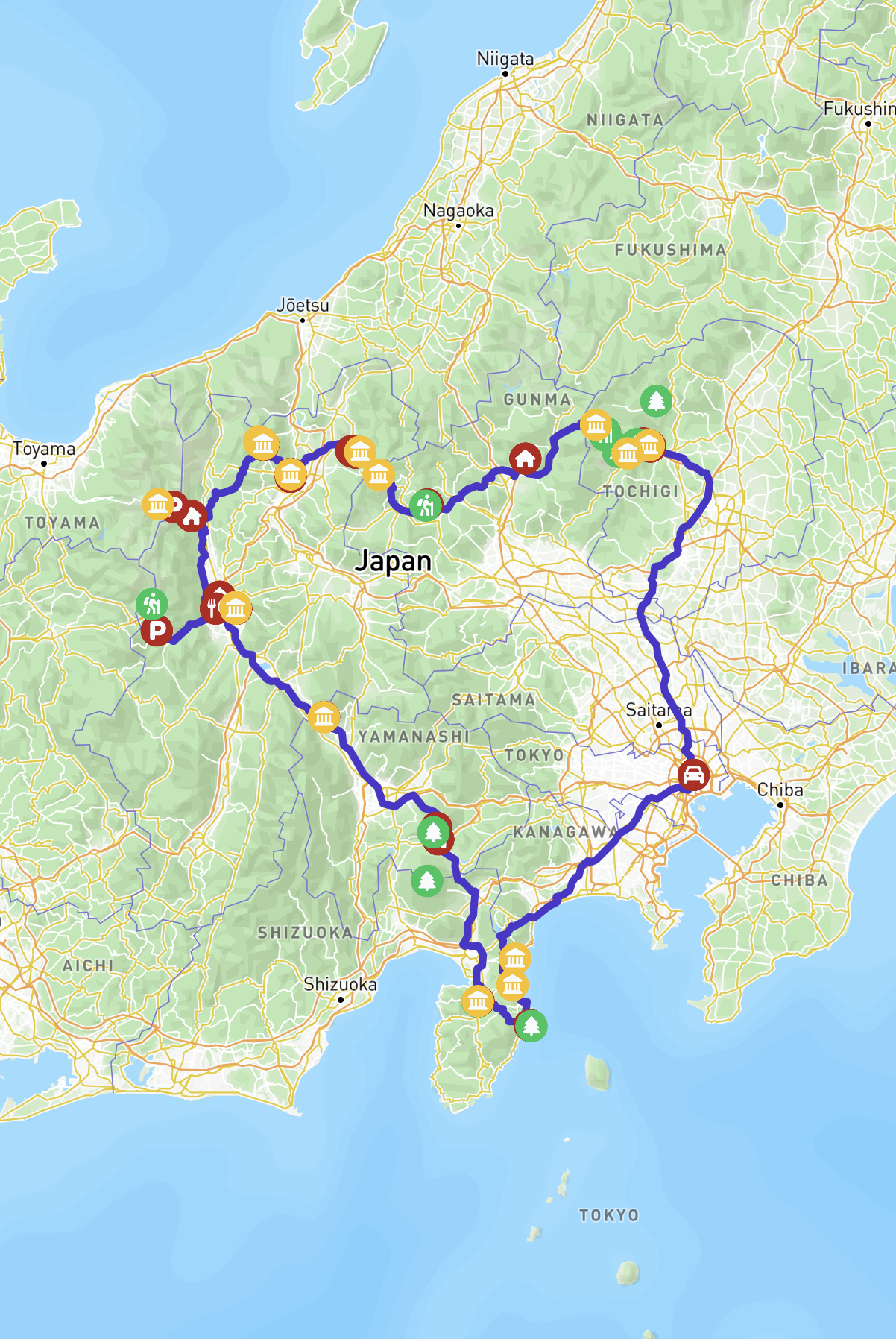
Japan: Spirited Away

5.00
1 review
We traveled through two regions of Japan: Chubu and Kanto. These areas are known for their national parks, mountains, winding alpine roads, and a remarkable concentration of temples. In the higher elevations you’ll also find many ski resorts, which makes autumn the perfect off-season: fewer visitors, quieter towns, and the freedom to explore major sights without crowds.
- Days9
- Distance1,052 km
- Spots52
- IntensityChill
Full route
- Tokyo - Nikko
- Nikko - Urami Falls - Kegon Falls - Yudaki Falls - Kawaba
- Kawaba - Agatsuma Gorge - Jigokudani Yaen-Koen - Yamanochi
Our to-do list
- Explore Nikko, visit Nikkō Tōshō-gū, stop by Meguri Coffee, stroll the main street, and enjoy the peaceful mountain walks (Day 1)
- Hike to Urami Falls, marvel at Kegon Falls from the bottom level, and admire the bride’s-veil-like Yudaki Falls (Day 2)
- Drive through Agatsuma Gorge, take a short hike, don’t miss Jigokudani Yaen-Koen to see the snow monkeys taking hot bath in the wood (Day 3)
Interesting places we didn’t visit
- Download both places we visited and didn’t visit
- Distance160 km
- Spots5
That day, our goal was simple: take it slow. We wanted to get ready without rushing, pick up our rental car, and drive to our first destination — . I had initially planned to visit several spots in the park, especially Nikkō Tōshō-gū, but we also wanted to leave time to wander and experience the area at an unhurried pace.
We stopped at the lovely (vegan), took a walk along the main street, and only then headed back to our accommodation.
was located slightly outside the city, surrounded by nature. When we arrived, the host casually mentioned that just a few days earlier, a bear had wandered into the village. Spooky!
That night, we fell asleep to the sound of a bubbling river outside the window — exactly our level of comfort, and the greatest reward of staying so close to nature.
- Distance92 km
- Spots9
The next day was entirely dedicated to exploring waterfalls and lakes. is the cutest of them — it’s reached by a short hike, and most likely you’ll have it all to yourself. , on the other hand, is absolutely massive. Be sure to take the elevator down to the very bottom level — the view from there is simply breathtaking.
Nearby is a beautiful , a twin of the famous Italian Lake Como. Even without knowing that the Italian embassy’s villa is located there, I immediately noticed how strikingly similar the landscapes are.
The very last was probably the most beautiful of all, as it resembles a bride’s veil. We walked along a short to a kind of lake-marsh area, where warning signs reading “Caution: bears” were everywhere. It was there that I finally decided to buy bear bells, as it turned out this is the most popular time for bears to roam the forest and put on fat.
We spent the night in a , in an unusually huge . Apparently, a large family had lived there, because the entire upper floor was dedicated exclusively to a playroom.
- Distance119 km
- Spots5
Oh, is an absolutely incredible place — at first, you don’t even realize how high up you are. The Agatsumakyo Gorge Rail Bike “Agattan” is also located here: a bicycle-style trolley that runs along former railway tracks, letting you pedal through the gorge and enjoy the scenery, including a ride through the Tarusawa Tunnel.
Unfortunately, we didn’t have much time, so we only did a short hike before driving over a truly mind-blowing . The road we had originally planned to take was closed due to increased volcanic activity. This phenomenon is called fumaroles, when steam escapes through the ground, but we still managed to see and film it from a parallel road. It’s a fantastic place — one of the most scenic roads we have ever driven. I can only imagine how beautiful it must be in autumn.
After that, we were in a real hurry to reach the famous place where snow monkeys bathe in hot springs in winter, with snowflakes falling on them. It’s a , because the monkeys come there voluntarily and may choose not to show up at all. At the end of the day, they are given apples — not everyone gets one, but this isn’t their only source of food, as the forest provides plenty. There’s no need to be afraid: the monkeys are surprisingly indifferent to people, even if you stand very close to them.
We ended the day in a in the town of . Before arriving, I didn’t know that this area has a large number of hot springs, or that people walk around the streets in bathrobes from one place to another. It’s a real resort — don’t miss it.
- Distance107 km
- Spots9
Don’t miss in — it’s an extraordinary place with an equally extraordinary history. Nagano once hosted the Winter Olympic Games, and the part of the city surrounding the temple is especially beautiful and charming. The temple itself is famous for housing the first Buddha statue ever brought to Japan, although it cannot be seen — even a replica is displayed only once every seven years.
is also unique in that it welcomes followers of all Buddhist schools, as well as non-religious visitors. There is also a special experience available to everyone — slightly scary, but unforgettable. It involves walking through a completely dark corridor in search of the “key to paradise”. This key is actually a door handle, located at the end of a long passage with no light at all, guided only by a handrail along the wall. If you’re not panic-stricken by darkness or confined spaces, this is a must-have experience.
A mystical atmosphere awaited us as well in , where a staircase lined with giant cedars leads to a at the top of a hill. Along the way, you’ll encounter many white zigzag paper streamers. They symbolize the presence of kami — spiritual beings that embody the forces of nature. And indeed, the nature there feels especially alive and mystical.
At the very last moment, a standard we had booked turned out to be the best hotel of our lives. We’ve stayed in many places around the world, but we had never experienced this level of Japanese luxury combined with such incredible views. The building had just opened, the rooms looked exceptionally stylish and refined, and my husband was equally impressed by the comfortable lobby workspace, the convenient shops (which turned out to be perfectly timed), the food, and the overall level of service.
- Distance35 km
- Spots3
On this day, I had planned a big hike to the summit of Mount Tateyama. Spoiler: I didn’t check that access to the mountain is only possible from the other side.
After arriving at the large , we took a bus to , where an incredible view opens up over the tallest dam in Japan — 186 meters high. It was built back in the 1960s, and the construction process was extremely difficult, yet it is still fully operational and continues to supply electricity today.
After crossing the dam, you can take a cable car from Kurobeko Station to Kurobedaira, and from there continue to the very top by ropeway, with views of the lake leading toward Tateyama. Be sure to check the weather: when we arrived, the entire summit was covered in white clouds, and inside this milky fog we couldn’t see anything at all.
And just as I mentioned earlier, only after reaching the uppermost point did I realize that we wouldn’t be able to hike to the summit from there. The only way up is by taking a bus to Murodo Station and starting the ascent from that side.
Here’s a route map to make it clearer.
The last bus leaves fairly early, so we wouldn’t have had enough time to reach the station, climb the mountain, and return. If you want to make the ascent, either start very early or plan the hike from the Toyama side from the beginning.
We also attempted a hike downhill from Kurobedaira Station back to the dam, but after about ten minutes the trail became extremely overgrown. We constantly had to push branches aside, and I’m not very used to walking along such wild, empty trails while thinking about bears fattening up for winter. That said, people did go down the trail after us — just more confident travelers than we were.
Surprisingly, on the way back home we saw many monkeys eating прямо on the road. Be careful if you’re driving at night — and honestly, during the day as well.
- Distance102 km
- Spots4
I had set aside a whole day for a trip to , because in all the lists it’s considered one of Japan’s main natural highlights, second only to Mount Fuji. We left the car at , since Kamikochi is a car-free area and can only be reached by special buses or official taxis. From there, you can choose your own walking route — this site shows all the stops and trails, many of which are easy enough to do with children:
As for the valley itself, the views from the bridges are, of course, impressive. The forest is beautiful, and I especially loved the view from Myojin Bridge. Be prepared for quite a few people, especially on a nice day. It’s probably best to arrive a little earlier or start from one of the earlier stops, but I still enjoyed it despite the crowds. I particularly love photos taken in November, when all of Japan is incredibly colorful and mysterious.
That night, in the suburbs of , not far from Nakagaya Station, so we could explore the city and the castle a bit more thoroughly the next morning.
- Distance156 km
- Spots8
The next day, we started by exploring the city of . The city was formed during the samurai era and is known for having one of , built in the late 16th century. The castle is original, not reconstructed. Of course, it doesn’t look like a European castle — it’s designed as a rather spacious and tall tower with numerous defensive features. Although the castle was never actually attacked, it still gives a strong sense of readiness for battle and a genuine samurai atmosphere.
On our way to our hotel with views of , we stopped at the stunning . It’s a unique place, set in a picturesque natural location among forests. Visiting it gives the feeling of discovering a hidden gem, a place nobody knew about before you. The museum houses over 200 works by Haring from 1980 to 1990, including paintings, sculptures, and drawings. All of these pieces were collected by one person — an entrepreneur and philanthropist — who also chose the location for the museum and the Hotel Keyforest Hokuto, both designed by Atsushi Kitagawara. Both buildings are impressive, and the surrounding forest contrasts beautifully with the ultra-modern design, creating a sense of harmony and beauty.
And now, the not-so-pleasant part of our trip begins. We had booked a room in a beautiful, fairly expensive hotel with a view of Mount Fuji. You don’t have to stay right at , there are plenty of places with great views of Mount Fuji, but there are plenty of hotels to choose from. The grounds of this were stunning, and the view was enchanting, but we got unlucky with our room — we stayed on the lower floor of a large house and could hear the neighbors above us. On top of that, in such a high-end hotel, we had to buy cooking oil and salt from a special shop on site, which completely clashes with Japanese cultural expectations. As we realized, the hotel is not run by Japanese staff, and the odd service threw us off a bit, especially after getting used to how seriously people here take hospitality. So, DON’T book the Modern Suite Barrel Sauna at Kawaguchiko country cottage ban.
A few hours later, we realized that eavesdropping on the neighbors would make it impossible to relax, so we quickly found on Booking and left, leaving the keys at reception.
- Distance108 km
- Spots4
The trip to the Izu Peninsula was a real discovery for me. We barely explored it, and it’s a place I would love to return to many times. The nature there is stunning, and it has a truly island-like atmosphere. Bamboo mixes with pine trees, the roads are one more beautiful than the other, and on top of that, the coastline is absolutely breathtaking.
We headed straight to the center of the peninsula, to and the , walked around the town, and stopped at the charming . I don’t know what they put in their food, but that was one of the most delicious sandwiches I’ve ever had. Around the temple, there’s a delightful village, and if you’re with children, you can also walk to the themed park Shuzenji Niji-no-Sato and take a ride on the little train.
On the way to our accommodation, we drove along a fantastically beautiful road through a misty forest. The peninsula is home to one of the most scenic roads in Japan, the Izu Skyline, which offers great views of Mount Fuji. But we took a slightly different route, and it was the right choice — our path led through an amazing, foggy, and very mysterious forest, an experience I will never forget. Rain, a narrow road, thick mist, and giant trees stretching up to the hilltops.
- Distance174 km
- Spots5
I absolutely wanted to visit the coast and admire the blue seaside from “Ponyo on the Cliff” by Hayao Miyazaki. If you head to the opposite side of the peninsula, you can enjoy unique, breathtaking views of Mount Fuji framed by the sea and clouds. In short, any coastline on the peninsula will leave you enchanted.
From our accommodation, it was very close to , where you can walk across the Kadowaki Suspension Bridge and take countless beautiful photos. From there, you can also follow the coastal trail to Izu Oceanic Park, but we decided to head to a museum instead.
I had originally planned to visit The Hakone Open-Air Museum, a huge outdoor museum with countless pavilions and works by Picasso and other famous artists. However, it wasn’t on our route, so we decided to stop at the , and we didn’t regret it. Across several floors, the museum presents the 17th-century Japanese epic “The Tale of Princess Jōruri”. This classic legendary tale tells the story of the young man Ushiwaka and his love for Princess Jōruri, daughter of a powerful samurai. The work is breathtakingly beautiful, with intricate details that make it hard to imagine how many painstaking hours went into creating it. The story is truly captivating and never feels outdated.
After bidding farewell to the museum, we happily drove along the highways back to . Adventures awaited us in Kyoto and Osaka, but that’s another story entirely.