Cornwall: wild coast

5.00
1 review
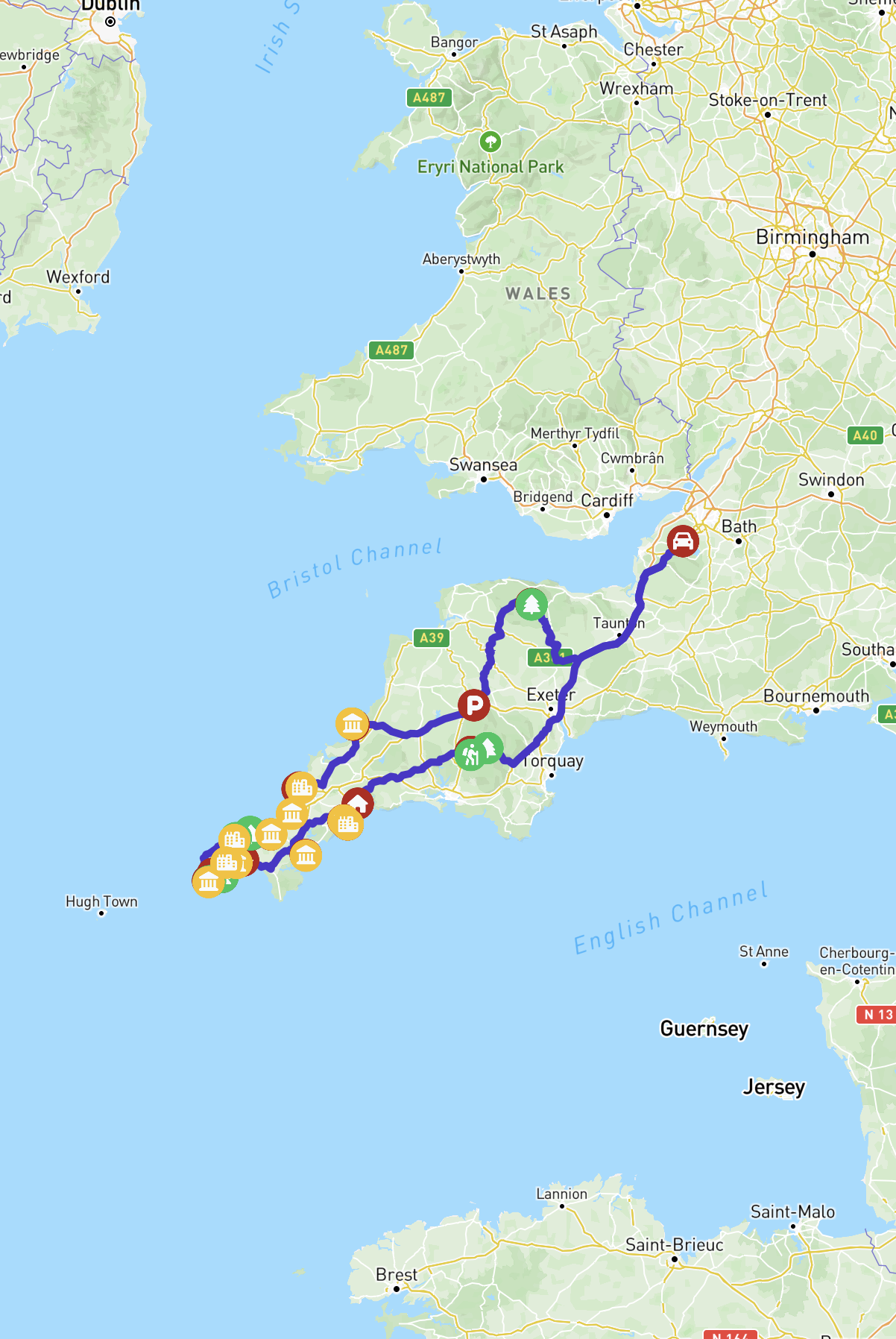
Cornwall is a region of stunning coastal landscapes — at times it feels like a mix between Portugal and France, but with its own unmistakable British charm. You’ll find everything here: national parks, castles, historic mines, and of course... the beaches! Endless, beautiful beaches. That said, a word of advice: drive carefully and don’t rush. The roads may be scenic, but they’re also narrow and twisty. Take it slow—it’s all part of the adventure.
- Days7
- Distance796 km
- Spots32
- IntensityChill
Full route
- Bristol - Dartmoor National Park - Foggintor Quarry - Par
- Par - Mevagissey - The Lost Gardens of Heligan - Pendennis Castle - Goldsithney
- Goldsithney - St Michael’s Mount - Penzance - Lamorna Cove Beach - St Buryan
Our to-do list
- Relax by the lakeside at Fell Foot , a scenic spot perfect for a picnic or paddleboarding (Day 1)
- Explore the rugged landscapes and stunning views at Dartmoor National Park
- Make a walk around the atmospheric Foggintor Quarry (Day 1)
Interesting places we didn’t visit
- Download all the places
- Eden project
- Salcombe
- Distance224 km
- Spots2
Day one definitely kept us on our toes. If you’re booking a car, make sure to double-check the company’s terms on their website—because we weren’t so lucky. Turns out, our brand-new driver’s licenses were too new to be accepted. So we had to make a last-minute trip to the airport to rent a car there, even though it was much more expensive. Still, that didn’t ruin our trip in the slightest.
In the end, none of that mattered. One of the most delightful surprises was the drive through . The road itself was gorgeous, winding through wild scenery with ponies casually hanging out like they owned the place. And then came the highlight: a completely unplanned hike around . What we thought would be a quick 20-minute stroll turned into a misty, slightly mysterious hour-and-a-half wander through the fog. I’m pretty sure that place looks amazing no matter the weather—but the rain and mist really turned it into something straight out of a fantasy novel.
- Distance97 km
- Spots4
The next day was all about choosing between three gardens. Our contenders were: the Eden Project, Trebah Garden, and . Since my husband has some back issues, we ruled out Eden—it’s absolutely massive, and probably better suited to those ready for a full day of walking.
We started the day with a stroll through what we thought would be a quiet little fishing village—and accidentally ended up at a local festival in the charming town of . If you’re nearby, definitely stop by—it’s the kind of place that feels like a postcard come to life.
Also The were just a short drive away. Unlike some other major attractions, it’s not part of the National Trust or English Heritage, so tickets are a bit pricier—but it’s worth it. It was fully restored by Tim Smit, creator of The Eden Project, and now it features exotic jungle paths, giant rhododendrons, and living sculptures like the Mud Maid and Giant’s Head. The grounds are quite spacious, so you won’t be bumping into people every two minutes.
Later in the day, we looked for somewhere to squeeze in a quick walk—and just managed to catch before closing.
“ is a coastal fortress built by King Henry VIII in the 1540s as part of a chain of defenses against France and the Holy Roman Empire. It saw action during the English Civil War and remained in military use all the way through World War II.”
The castle itself is compact and really lovely inside—its medieval halls can even be rented for weddings (super atmospheric). But what really stuck with me were the coastal signal rooms and the WWII-era weapons still on display. A surprisingly immersive experience. Highly recommended, especially if you’re into history, tech, or anything with cannons.
- Distance24 km
- Spots3
This day was all about visiting —one of the few sights in Cornwall I knew I absolutely had to see. I still vividly remember our visit to a nearly empty Mont Saint-Michel back in 2020—it left a lasting impression. So naturally, I was curious to see its Cornish “sister castle.”
is still a lived-in castle, with the resident family occasionally offering guided tours themselves. From the top, the views are absolutely stunning—both out to sea and down over the gardens that surround the base. I’d definitely recommend walking through the gardens too—they offer the most spectacular angles of the castle’s stone walls.
We were lucky with the tides and got to take the boat both to and from the island. The water was high, and honestly, I’m glad we didn’t walk the causeway—it made the whole experience feel a bit more magical.
Next stop: —and I’ll be honest, this was the one letdown of the trip. The town just didn’t charm us at all. If you’re short on time, I’d say skip it without regrets.
Before heading off to check into our next stay, we wanted a bit more nature—and found it at the lovely little . It’s small, quiet, and beautifully tucked away. Just one tip: bring coins for parking, unless you want to end up buying snacks in the nearby shop just to get some change.
- Distance63 km
- Spots5
Porthcurno has it all—a clifftop theatre, stunning beaches, scenic hikes (bonus: sometimes with horses). But I’ll be honest—the real reason I wanted to go was , which I’d spotted on Instagram ages ago and immediately bookmarked with heart-eyes.
Our host warned us in advance that the path down to the beach is not easy and she wasn’t exaggerating. The descent is steep, rocky, and definitely not suitable for kids or anyone with mobility issues. But once you make it down? Totally worth it. Probably the most beautiful beach we saw on the entire trip. It’s small, secluded, and feels like the definition of romance.
The whole Porthcurno coastline is gorgeous, including the main itself. We also followed a clifftop trail up to Logan Rock, which gives you a perfect view of the . We could even hear live music from a performance happening below. It was a hot day, though, and sitting in the open sun didn’t sound too appealing at the time. But we’re definitely coming back to experience the theatre properly—it’s too iconic to miss.
Another spot that came highly recommended was Nanjizal Bay, just nearby. Unfortunately, we were told that recent rockfalls had made the coast there harder to explore, and that the famous views might be blocked off.
Then came the north coast, which we kept hearing described as a “living painting”—and its crown jewel: . Our host originally advised us to park at St Erth and take the scenic train into town (apparently, the views from the train are amazing). But we were feeling bold and drove in instead—barely snagged a parking spot, but made it!
has an incredible vibe. The town seems to change color and character with the weather—always beautiful, but never quite the same twice. It’s stylish, cozy, artsy, and endlessly photogenic. We loved it so much, we came back again the next day.
- Distance84 km
- Spots11
If you’re a coffee lover, a cappuccino from is exactly the kind of pick-me-up that’ll carry you through the rest of the day.
Next, we headed to —one of the few spots where you can see seals up close at . And we actually did spot a few! Just a couple lounging on the rocks, but still—total win.
Originally, I’d planned this day as more of a “coastal exploration and beach-hopping” kind of thing. But honestly, after Godrevy’s stunning views and sea air, we felt ready for something different on the way to Newquay.
In hindsight, I think we would’ve loved Kennall Vale Nature Reserve—a peaceful forest walk would’ve been perfect. But at the time, we didn’t know it existed. Instead, we took a spontaneous detour to the (National Trust)—and luck was on our side.
We were the only visitors there and ended up getting a private tour. The mine is part of a historic chain of 18th-century sites that were used to extract various metals. The main highlight? A massive and beautifully preserved steam engine that used to pump water out of the mine. It had to run constantly—any pause in operation risked flooding not just this mine but the entire network around it. It’s not a super well-known place, but it left a big impression. Seeing that kind of old industrial tech up close, and hearing all the stories—it was way more fascinating than I’d expected.
To celebrate the day, we swung by for a treat. Highly recommend trying the chilled apple wine—light and refreshing.
Now, completely caught me off guard—in the best way. I honestly hadn’t expected it to be so charming. We only stayed one night, but I’d happily have stayed longer. The beaches are insanely wide—reminded me of Normandy, which left a similar impression on me years ago. Turns out, is also the surf capital of the UK, and that becomes obvious pretty quickly: surfers everywhere, surf shops on every corner, and tanned, shaggy-haired guys hanging out in every café.
My brother especially appreciated the photos of the local golf course—because yes, it’s right next to the beach.
- Distance180 km
- Spots6
We may never know for sure whether King Arthur truly existed—but honestly, I’m just glad the legend does. And I’m especially glad it’s tied to this place, because everything here—the cliffs, the caves, the bridges—feels like it’s been pulled straight from an epic tale.
Thanks to Geoffrey of Monmouth (12th century) and later Tennyson’s Idylls of the King, became a key location in the Arthurian legend, and later also in the stories of Tristan and Isolde. Whether myth or memory, the atmosphere is absolutely real. The views are stunning—and the (from the Cornish word for “power”) is nothing short of mesmerizing, standing on the cliffs like a shadow of legend made bronze.
If we’d had more time after visiting the castle, I’d have loved to see St Nectan’s Waterfall or go for a walk in Rocky Valley. But our hotel was a bit of a drive, and instead we opted to take our time and enjoy the route through .
Fun fact: it can snow there in winter—and not just a dusting, but actual snowdrifts! Highly recommend taking the scenic drive through the park regardless of season. There’s a fresh, cool feel to the whole area—something we really appreciated, especially after leaving behind 35°C heat in London.
Our for the final night was set in a stunning historic house, lovingly restored by the owners using old photographs as references. It was the perfect place to end the trip—peaceful grounds, a beautifully preserved interior, and hosts who made us feel completely at home. No regrets at all about choosing it as our last stop.
- Distance125 km
- Spots1
On our final day, we chose to continue our drive through —we just couldn’t get enough of those breathtaking landscapes. One thing became clear: we’re definitely coming back to Cornwall. There’s a unique atmosphere here that we haven’t found anywhere else in the UK. It’s wild and peaceful all at once, full of character and quiet magic.
, especially, left a lasting impression. Its laid-back vibe, wide beaches, and that easy pace of life—there’s just something about it that makes you want to come back in summer and stay a little longer. Maybe a lot longer.