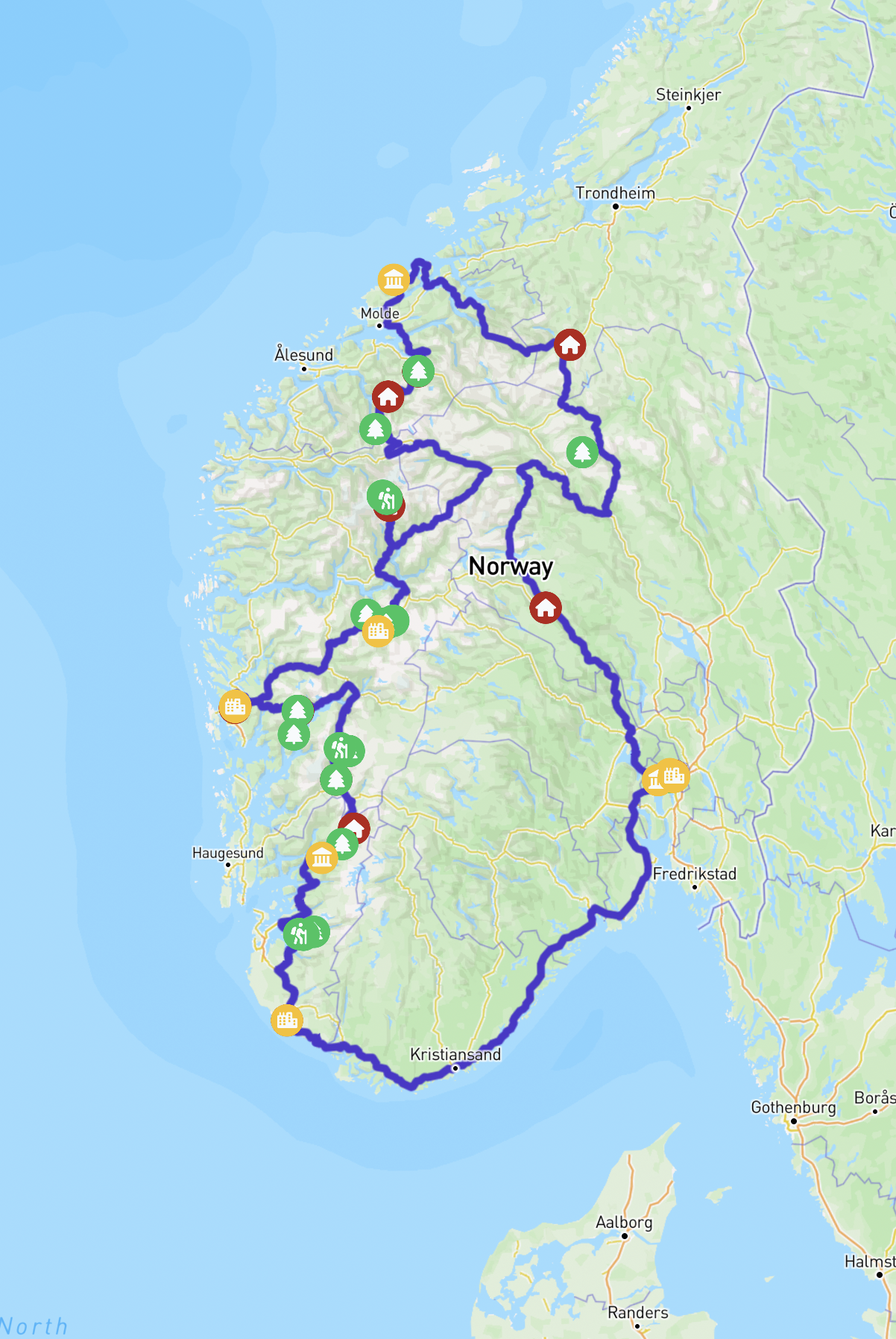
Norway: The Waterfall Paradise

5.00
1 review
June is a perfect time for a road trip through Norway. The weather is pleasant, with chances to see a lot of waterfalls and the midnight sun further north. You can expect long days to explore dramatic fjords, charming towns, and scenic drives. All our route was based on the scenic road map of the official website of Norway. That’s why we haven’t visited many sights but saw a lot of fantastic landscapes. Before travelling to Norway, check if roads are closed.
- Days10
- Distance2,499 km
- Spots40
- IntensityIntense
Full route
- Oslo - The Royal Palace - Aker Brygge - Oslo Opera House - Oslo
- Oslo - Egersund
- Egersund - Oanes - Preikestolen - Sand - Kvednahola at Vasshus - Suldalsvatnet - Nesflaten
Our to-do list
- Visit the quirky Vigeland Sculpture Park for its unique sculptures (Day 1)
- Admire the stunning Opera House overlooking the fjord (Day 1)
- Stroll along the chic Aker Brygge waterfront with its modern architecture and sleek yachts (Day 1)
Interesting places we didn’t visit
- Under Lindesnes: A unique underwater dining experience in Lindesnes.
- KOK Oslo Sauna, Langkaia: A floating sauna experience in Oslo.
- The National Museum (Oslo): The largest museum in Oslo, showcasing art, architecture, and design.
- Distance0 km
- Spots6
Our first stop was Oslo, Norway’s vibrant capital. In just a few days, we managed to see all the major sights, including the quirky Vigeland Sculpture Park, the stunning Opera House overlooking the fjord, and the chic waterfront. With its sleek yachts and modern architecture, this area is especially charming.
Compared to other European cities, Oslo is relatively small. While the city has a reserved atmosphere, it still offers everything you’d expect from a capital: , expansive parks, and striking Scandinavian design.
Also I couldn’t help but mention the famous ice floe-shaped —it blends seamlessly into the Norwegian landscape, just like all the country’s architectural masterpieces. You can easily walk up its sloping roof to enjoy breathtaking views of the city, while the interior feels minimalist and spacious.
Although Norway isn’t particularly known for its capital city, Oslo provides a compact and well-maintained glimpse into the country’s culture and lifestyle. Its clean streets and pleasant ambiance make it a delightful place to explore.
- Distance485 km
- Spots2
This was our first road trip together, and we weren’t as seasoned as we are today. Looking back, I wouldn’t have covered such a long distance so quickly on the first day. But our enthusiasm carried us, and the beginning of our journey was all about immersing ourselves in Norway’s spectacular natural world.
Just a short 20-minute drive from Oslo, it becomes clear why so many people are drawn to Norway’s landscapes. The scenery transforms as you leave the city—expansive forests, rolling hills, and sparkling rivers seem to invite you to explore deeper.
The first thing that struck me was a bridge designed to provide a safe crossing for wildlife—a thoughtful touch that reflects Norwegians’ deep respect for nature. Along the way, we passed breathtaking waterfalls tumbling down rocky cliffs, a tranquil quarry with crystal-clear water, and winding rivers that seemed to flow endlessly. Each stop offered a glimpse into Norway’s pristine wilderness and the careful stewardship its people have for their natural surroundings.
Our first destination was , a charming little town with cozy cafes, docked yachts bobbing gently in the harbor, and friendly locals who greeted us with warm smiles. Egersund felt like a peaceful retreat, the perfect spot to unwind and take in the gentle rhythm of Norwegian coastal life.
- Distance230 km
- Spots6
It was our first time taking a ferry, which carefully carried us from one side of the fjord to the other. The way transportation functions so seamlessly in Norway feels almost miraculous. Bridges, ferries, and roads are effortlessly woven into one of the world’s most complex landscapes, as though they are natural extensions of the mountains, gorges, and fjords themselves.
That day, we planned to hike to , but just as we arrived at the trailhead, an unbelievably heavy rain began to pour. Knowing how slippery the rocky terrain would become, we decided it was safest not to proceed. If not for the weather—and with the right footwear—we wouldn’t have missed out on the fantastic view over .
On our way to the cozy apartment we’d rented by the fjord, we stumbled upon a traditional wooden sawmill and stopped for a quick look. These sawmills are beautiful examples of pre-industrial water power in action, blending engineering and nature. Later, we stopped in a tiny town for lunch, and to my surprise, the little pub, Kulp AS, in the equally small town of Sand, had announcements for upcoming stand-up comedy performances—a charming glimpse of local culture in such a quaint place.
- Distance254 km
- Spots9
Norway is the perfect place to explore beyond the big cities, staying instead in nature and charming small towns. That’s exactly what we did, stopping in the little town of . Though it has only a handful of houses, Nesflaten offers all the essentials: a large store, restrooms, a parking lot for camper vans, and even a charging station for electric cars. It’s truly Norway in miniature.
In the morning, we woke up to a breathtaking view of the fjord, framed by mountains with waterfalls cascading down from every side. These falls, however, were just a prelude to the incredible sights awaiting us further along the road. Soon, we encountered , the most powerful and awe-inspiring waterfall I’ve ever seen, its roaring flow practically filling the valley with mist and energy. Yet, even this was not the last of the day’s mesmerizing waterfalls.
Next, we visited , a unique waterfall where you can actually walk behind the rushing water while staying completely dry—a thrilling experience. And we couldn’t overlook ; this incredibly cozy city has treasures beyond the famous and waterfront. We wandered into a beautiful, serene garden called Muséhagen, a hidden gem with lush greenery and winding paths. I’m sure Bergen holds countless more surprises, each as delightful as the last.
- Distance310 km
- Spots5
That day, our final destination was the Glacier. This part of the journey felt magical, as we left the warmth of summer behind and transitioned to roads lined with towering walls of real, icy snow.
If you’re short on time and not claustrophobic, the tunnel is a quicker option. However, the view from the old road overlooking from the is worth every extra minute. On this route, you can experience all four seasons in just a few hours. As you climb to an altitude of 1300 meters, each turn reveals a new landscape that’s more breathtaking than the last.
- Distance307 km
- Spots3
Of course, the highlight of the day was our visit to the breathtaking Glacier, an arm of the larger Jostedalsbreen Glacier.
Famous for its stunning blue ice, Nigardsbreen is also one of Norway’s most accessible glaciers, allowing visitors to get remarkably close—and even walk on the ice, as we did. We recommend arriving early to secure a parking spot and taking the boat ride across the lake to the glacier for a quieter experience. From there, you’ll need to hike over rocky terrain to reach the glacier, which can be challenging but is absolutely worth it. Keep in mind that the glacier is shrinking each year, so don’t miss your chance to witness this natural wonder up close. For an even more memorable experience, consider joining a guided tour to explore the glacier’s interior—a truly incredible adventure.
Continuing our journey, we reached a stunning spot where black, rugged mountains contrasted sharply against patches of white snow. Nestled at a high elevation, Djupvatnet Lake remains partially frozen for much of the year, surrounded by dramatic, often snow-capped peaks. It’s a popular stop along the scenic road leading to the , one of Norway’s most iconic and breathtaking vantage points.
Our final stop of the day was the charming village of Sylte, located in the fertile Valldal Valley. Known for its mild microclimate, Valldal is famous for its strawberry production, and the lush valley scenery provided a beautiful and serene way to end the day.
- Distance361 km
- Spots2
We had an incredible day ahead, driving along two of Norway’s most stunning routes: and the .
Trollstigen is famous for its steep incline and eleven sharp hairpin bends, ascending a 9% gradient up a mountain pass. The road offers breathtaking views of waterfalls, deep valleys, and rugged peaks. Two highlights include the Stigfossen Waterfall, which flows directly beneath one of the road’s bridges, and a modern viewing platform at the top, where visitors can safely admire the dramatic twists and turns of the road below.
The Atlantic Road truly deserves to be seen from above, as only a drone’s-eye view fully captures its beauty and uniqueness. The road winds through a complex and picturesque landscape, consisting of eight bridges that dip, curve, and arch over the powerful waves of the Norwegian Sea. You may already be familiar with the famous Storseisundet Bridge, often called the “road to nowhere”. This nickname stems from its distinctive design and angle, which makes it appear as though the road suddenly drops into the sea. But don’t worry—it doesn’t!
- Distance366 km
- Spots1
Our journey back to Oslo took us through stunning national parks over the next two days. We enjoyed a scenic drive along the Valdresflye and passed through , known for its numerous trails and breathtaking views of lakes and waterfalls.
Here are some of the trails we explored:
We stopped frequently along the road, as this was our last chance to see snow before summer ended. turned out to be a very small village, but it was home to one of Norway’s largest open-air museums, the Valdres Folk Museum.
- Distance185 km
- Spots2
The next day, we rushed to Oslo. If I were on that route now, I would definitely stop by the Kistefos Museum. It’s a mix of industrial history and contemporary art, seamlessly integrated into the beautiful Norwegian landscape.
Just before arriving in Oslo, we made a quick stop at to finally try out a two-seater canoe. Pro tip: leave your valuables behind—it’s surprisingly easy to tip over. And the unexpected swim to the nudist beach was… let’s just say, an experience. But hey, to each their own!
- Distance0 km
- Spots4
On the last day, we had arrived as early as possible so we could explore the city one more time.
A stroll through is a must, with its unique sculptures and a wonderfully relaxing atmosphere. For a deeper dive into history, and its surroundings are the perfect pick. I’d recommend hiring a guide—they’ll share fascinating and unexpected stories about the place, like the legend of Malcanisen, the ghostly dog said to guard the fortress.
If I were to visit Oslo again, I’d definitely set aside half a day for the Kon-Tiki Museum, especially after recently visiting the Portsmouth Historic Dockyard in the UK, which sparked my interest in all things nautical. The museum’s main attraction is the original Kon-Tiki raft, which Thor Heyerdahl, a famous Norwegian adventurer, ethnographer, and author, used to sail from Peru to Polynesia with his crew.